Description
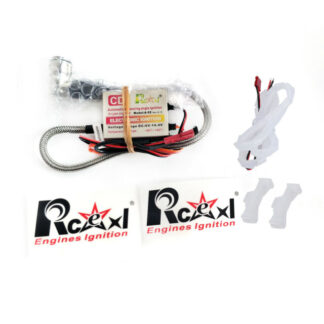
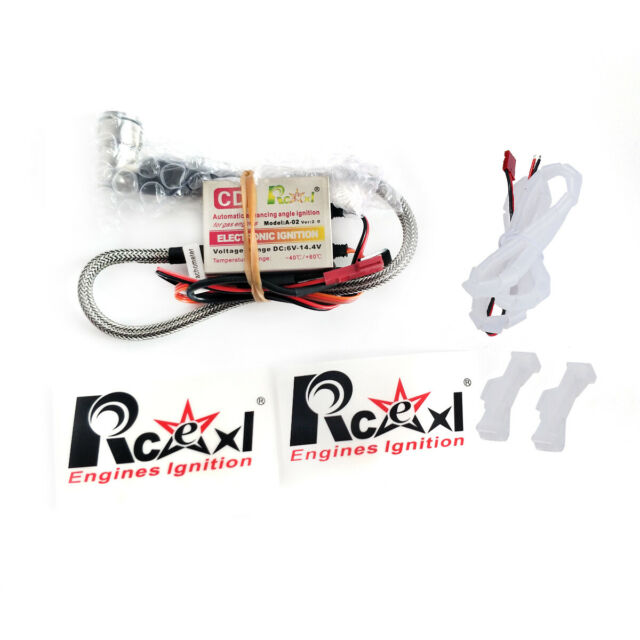
RCEXL ignition systems can be used on a wide range of engines both singles and twins and more are being released regularly
The table below lists the model number according to the type of cap that it fits.
All RCEXL ignition systems run on 6 to 14.4 volts which mean that they work will with 5 cell NiMh, 2s or 3s lipo batteries and more.
| Model No | Description | Plug Type | Voltage | Cap Degree |
| 1121 | Single ignition for ME-8 1/4-32 | ME-8 1/4-32 | 6V~14.4V | 90° |
| 1122 | Single ignition for ME-8 1/4-32 | ME-8 1/4-32 | 6V~14.4V | 90° |
| 1123 | Single ignition for ME-8 1/4-32 | ME-8 1/4-32 | 6V~14.4V | Straight |
| 1124 | Single ignition for CM-6–10MM | CM-6–10MM | 6V~14.4V | 90° |
| 1125 | Single ignition for CM-6–10MM | CM-6–10MM | 6V~14.4V | 90° |
| 1126 | Single ignition for CM-6–10MM | CM-6–10MM | 6V~14.4V | Straight |
| 1127 Uk Stock! | Single ignition for BMR6F-14MM | BMR6F-14MM | 6V~14.4V | 90° |
| 1128 | Single ignition for BMR6A-14MM | BMR6A-14MM | 6V~14.4V | 90° |
Twin Cylinders Ignition ( Ver 2 ):
| Item No | Description | Plug Type | Voltage | Cap Degree |
| 1221 | Twin ignition for ME-8 1/4-32 | ME-8 1/4-32 | 6V~14.4V | 90° |
| 1222 | Twin ignition for ME-8 1/4-32 | ME-8 1/4-32 | 6V~14.4V | 90° |
| 1223 | Twin ignition for ME-8 1/4-32 | ME-8 1/4-32 | 6V~14.4V | Straight |
| 1224 | Twin ignition for CM-6–10MM | CM-6–10MM | 6V~14.4V | 90° |
| 1225 | Twin ignition for CM-6–10MM | CM-6–10MM | 6V~14.4V | 90° |
| 1226 | Twin ignition for CM-6–10MM | CM-6–10MM | 6V~14.4V | Straight |
| 1227 | Twin ignition for BMR6F-14MM | BMR6F-14MM | 6V~14.4V | 90° |
| 1228 | Twin ignition for BMR6A-14MM | BMR6A-14MM | 6V~14.4V | 90 |